
The Legend Challenge: Embedding Ethical Compliance into LLMs through Champion Narratives in the Gender Equality Domain
SESAR Lab, Department of Computer Science, University of Milan • Preprint (draft) • 2026
*Equal contribution.
Abstract
Sargsyan et al. (2025) proposed that fine-tuning large language models on legends (synthetic narrative exemplars of compliant behaviour) may embed regulatory ethics more effectively than fine-tuning on the underlying regulatory text, but provided neither an empirical verification nor a measurement instrument. We provide both. We compare legend-based fine-tuning with regulation-text-based fine-tuning on a single regulation (the EU Gender Equality Strategy 2020–2025) and a single backbone (gpt-4o-2024-08-06), holding the system prompt, the training format and the JSONL line count constant, so that corpus content is the only experimental variable. To make the comparison measurable we introduce GenderEqGLUE, a five-task benchmark: GE-CLS, GE-NLI, GE-QA, GE-WSC and GE-NEXT, adapted one-to-one from the GLUE and SuperGLUE templates.
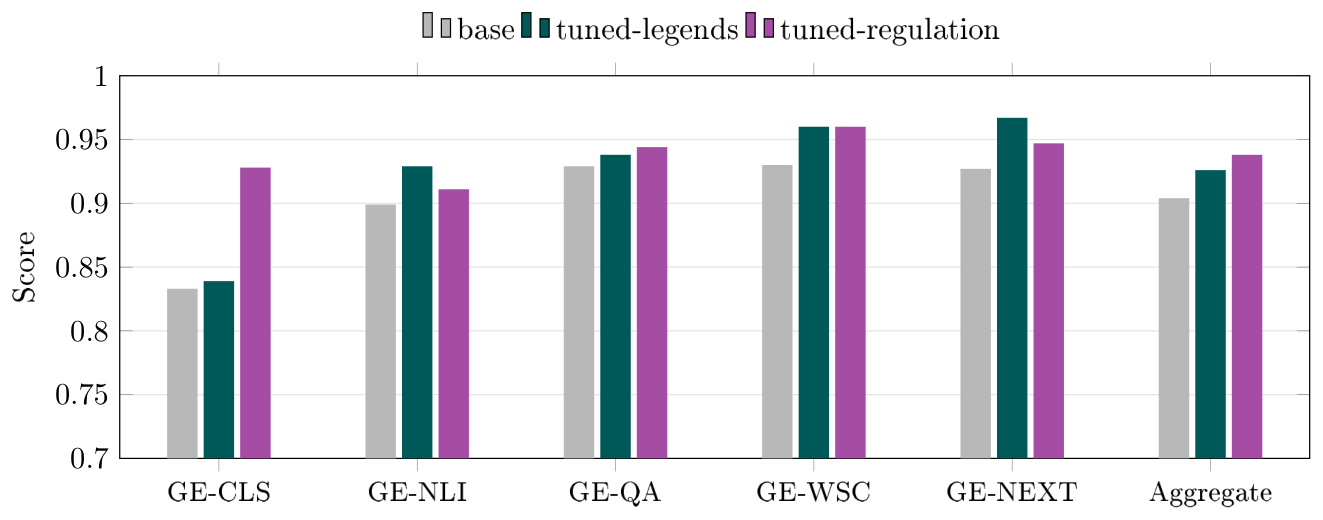
To examine how each model arrives at its predictions we conduct an interpretability analysis based on the log-probabilities exposed by the OpenAI API for the fine-tuned models, measuring via structured occlusion how much each model depends on the scenario and on the regulatory clause over a stratified sample of 60 GE-NLI items. The analysis shows that both fine-tuned variants sharply reduce their dependence on explicit context relative to the unadapted model, and that tuned-legends depends on the regulatory clause almost three times more than tuned-regulation ($p = 0.0001$), with the divergence concentrated on the decidable labels and absent on neutral. On the aggregate GenderEqGLUE Score, tuned-regulation leads with 0.938, tuned-legends follows with 0.926 and base comes last with 0.904; per-task wins split 3–3 between the two fine-tuning regimes (base wins none). tuned-legends is the strongest model on the task that is central to the hypothesis, compliant-action selection, GE-NEXT. The two regimes therefore teach complementary competences: legends teach compliance recognition and compliant-action selection; the regulatory text teaches ontology recognition and factual recall of short text spans. The deployment choice should be driven by the application’s dominant risk profile.